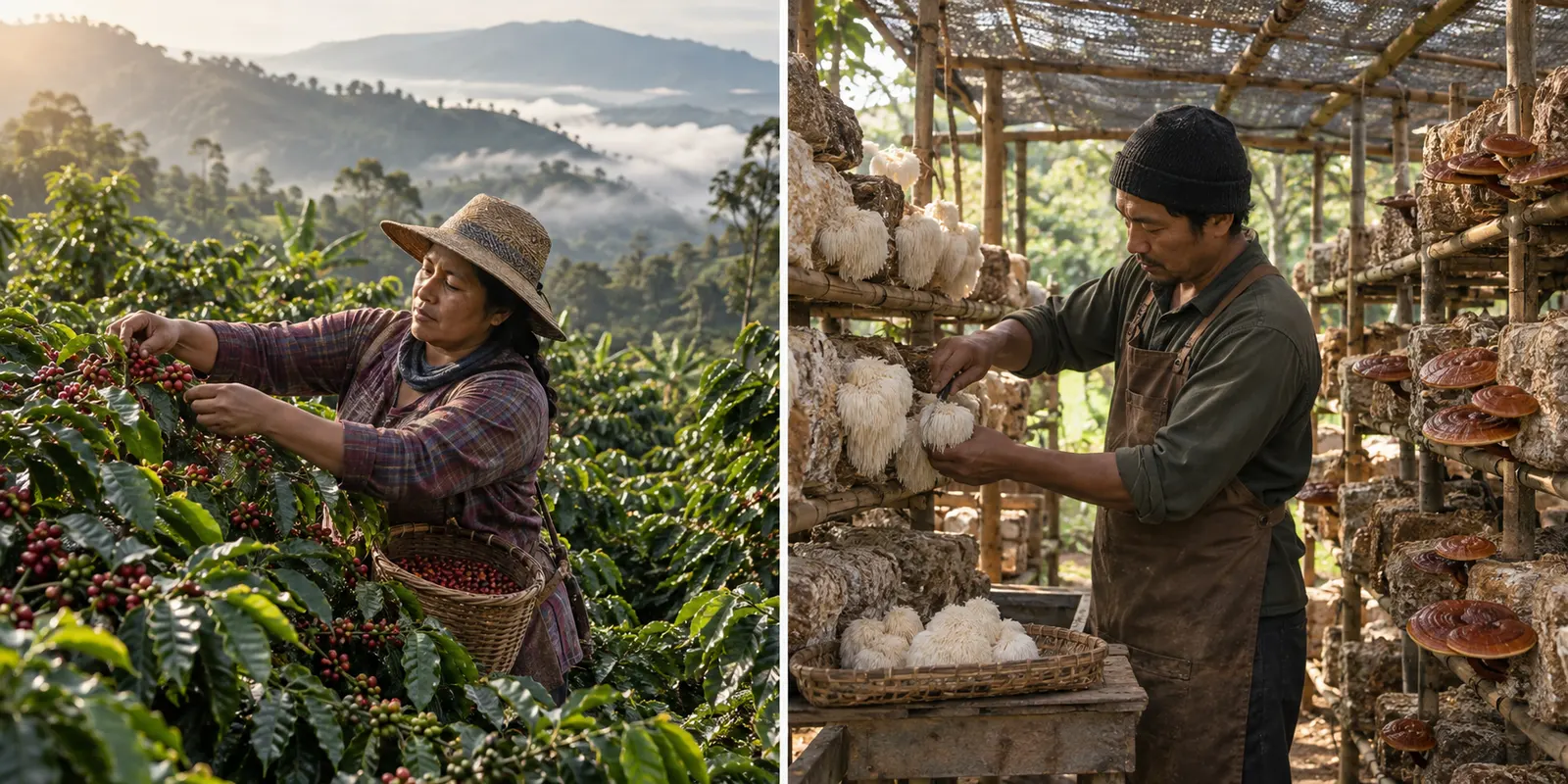
Product features are not clinical evidence.
The reviewed product contains ground coffee and five named mushroom ingredients in a single-serve pod. These facts do not establish a medical benefit.12
Ingredient studies differ in dose, preparation, duration and participants. The listing reviewed does not disclose individual mushroom doses, and the sources below do not establish a clinical effect of the finished Peak beverage.
Human studies: tested preparations are not coffee servings.
The amounts below describe experiments, not advice to take a dose or drink more cups. None establishes the dose delivered by the reviewed Peak pod.
| Study and participants | Tested preparation | Timeframe | Finding and transfer limit |
|---|---|---|---|
| Lion’s mane, Mori 2009: 30 older adults with mild cognitive impairment | Four 250 mg tablets, 96% mushroom powder, three times daily | 16 weeks | Cognitive-scale improvement during treatment; small, condition-specific tablet trial, not healthy coffee users.3 |
| Lion’s mane, 2023 pilot: 41 healthy adults aged 18–45 | 1.8 g daily | 28 days, with acute testing | Faster performance on one attention task after an acute dose; the stress trend after 28 days missed conventional significance. Other findings were null or negative. Exploratory results do not establish broad cognition or stress benefits from coffee.51 |
| Lion’s mane, 2025 acute crossover study | One 3 g standardized extract drink | 90-minute assessment; seven-day washout | Task-specific findings were inconclusive. Even a drink study applies to its tested formulation, not generic mushroom coffee.52 |
| Cordyceps-containing blend: 28 young adults | 4 g of a multi-mushroom supplement daily | One week; ten volunteers continued for two more | No significant treatment interaction after one week; later findings from a small continuation need caution. Does not isolate cordyceps or test coffee.4 |
| Reishi, Klupp 2016: 84 adults with diabetes/metabolic syndrome | 3 g reishi daily, with or without cordyceps | 16 weeks | Primary glucose and measured cardiovascular-risk outcomes did not improve. This result concerns this preparation and population, not every reishi study.53 |
| Turkey tail phase I: nine women completed after breast-cancer radiation | Dose cohorts of 3, 6 or 9 g daily | Six weeks | Safety/tolerability pilot, no placebo group; exploratory immune markers are not a healthy-drinker benefit or cancer treatment claim.5 |
These trials ask different questions. No trial of the finished Peak coffee was identified in the sources reviewed. Dose, population, preparation and endpoint should remain attached to any discussion of results.
For chaga, preclinical findings do not establish an anti-inflammatory benefit in coffee drinkers; the clinical reference notes limited human evidence.7
A study checklist: population, dose, form and outcome.
Read the participant group, preparation, daily amount, duration, comparator and outcome together. A laboratory marker, attention-task result and clinical diagnosis are different endpoints. Small studies and short follow-up leave uncertainty about reproducibility and long-term effects.
For a product comparison, check the ingredient and dose disclosures against the actual tested preparation. More coffee servings cannot repair a missing ingredient amount or make a different extract equivalent.
Focus, stress, immunity, gut health and mechanisms.
These are separate outcomes, not one general “works” claim. A plausible mechanism, antioxidant assay, immune marker or animal result is not evidence that a coffee drinker will feel or function better. Mechanism language needs the relevant experiment and its limitations; a pathway name alone is not a clinical conclusion.
- NGF (nerve growth factor)
- A body-made protein involved in the growth and survival of certain nerve cells.57
- BDNF (brain-derived neurotrophic factor)
- A protein involved in neuronal growth, maintenance and communication.58
- ATP (adenosine triphosphate)
- A molecule that supplies energy for cellular processes.59
Knowing what these terms mean does not show that a coffee changes them, or that changing a marker improves memory, endurance or symptoms. Beta-glucan measurements likewise describe compounds rather than a clinical result; see the ingredient glossary.
The studies cited here do not establish that the finished Peak drink improves focus, treats fatigue, relieves stress, prevents infection or improves gut health. Nor do they establish an optimal mushroom coffee serving for those goals. Caffeine is part of the formula and must be considered separately.2345678
Compare caffeine on a serving basis, and review personal safety and interaction questions. Choose a drink for documented features and preferences rather than a treatment expectation.
Caffeine: this is still coffee.
Peak Mushroom Coffee is caffeinated. The September 14, 2026 Amazon observation lists 105 mg per serving; that is a product-listing value, not an independent measurement of your brewed cup. The separate HIGH CAFFEINE versions are different variants. We do not promise lower caffeine, no jitters or better sleep.28
Your sensitivity, other caffeine sources and timing matter. Confirm a precise amount with the brand when you need to manage a specific intake limit.
Put personal suitability before the routine.
Ask your clinician before use if you are pregnant, breastfeeding, take medication or have a medical condition. Avoid ingredients to which you are allergic. Chaga references include concerns about oxalates and potential interactions, but a coffee ingredient list alone does not quantify exposure or establish a product-specific risk.78
The documented Peak features are organic coffee, five named mushroom ingredients and pod brewing. Do not substitute it for treatment or a clinician’s advice.
How to check a focus or immunity claim against a study.
Suppose a brand links a lion’s mane study beside a promise of everyday focus. Check the study population first: mild cognitive impairment in older adults is different from healthy students or office workers. Then match the preparation, daily amount, duration, comparator, and actual cognitive task. A result on one scale is not evidence of better work performance, and an undisclosed mushroom amount in a blend cannot be assumed to match a tablet protocol.35152
For an immunity claim, identify whether the endpoint was an infection, a laboratory marker, or tolerability in a small clinical study. The turkey-tail phase I report does not supply a healthy-drinker infection-prevention result. This check leaves a useful answer even when evidence is incomplete: a named ingredient may have research, while the finished drink’s claimed outcome remains unestablished.5
Read the broader mushroom-coffee evidence.
For ingredient-level benefits, safety, and formulation questions across the category, read the mushroom coffee evidence guide at Supplement Science Insights. The product and preparation details on this page remain specific to the labels and sources identified here.
Reviewed product
Peak Performance Mushroom Coffee, 18-count variant (ASIN B0CT64G865). Read the Peak pod review or compare the selected mushroom coffee pods.
We earn from qualifying purchases.Buy Nowon Amazon (opens Amazon in a new tab)